Full Screen Shortcut: Keyboard Keys for Windows, Mac, Chrome & More
Looking for the full screen shortcut on your computer? On most Windows PCs, the answer is F11. Pressing F11 hides the browser tabs, address bar, taskbar, and other window controls so you can use the entire screen for your current app.
On a Mac, the standard full screen shortcut is Command (⌘) + Control + F.
The exact shortcut can vary depending on the operating system and application, so this guide covers the most useful full screen keyboard shortcuts for Windows, Mac, Chrome, File Explorer, games, VLC, PowerPoint, and mobile devices.
Quick Answer: What Is the Full Screen Shortcut?
| Device or app | Full screen shortcut |
|---|---|
| Windows browsers | F11 |
| Windows laptop with function keys | Fn + F11 |
| File Explorer on Windows | F11 |
| Mac | Command + Control + F |
| Windows games / Terminal | Alt + Enter |
| VLC Media Player | F |
| PowerPoint slideshow | F5 |
| PowerPoint from current slide | Shift + F5 |
| Microsoft Store / some UWP apps | Windows + Shift + Enter |
For most Windows users, F11 is the first shortcut to try.
What Is Full Screen Mode?
Full screen mode expands a window to fill your entire display and hides the surrounding interface — the taskbar, title bar, and in a browser, the tabs and address bar too. It’s different from simply maximizing a window: a maximized window still shows all of that chrome around the content, while true full screen mode shows only the content itself.
The Main Full Screen Shortcut: F11 (Windows 10 and Windows 11)
Press F11 to toggle full screen in:
- File Explorer
- Web browsers (Chrome, Edge, Firefox, Brave)
- Many classic desktop apps (Notepad++, Adobe Acrobat Reader, the Photos app)
Press F11 again to exit. This is the same shortcut to full screen view on Windows 10 and Windows 11 — Microsoft hasn’t changed it between versions. It’s the one shortcut worth memorizing first, since it’s what most people mean when they search for “the full screen shortcut.”
On many laptops, the F-row doubles as brightness, volume, or media controls by default, so F11 might do nothing — or dim your screen instead. If that happens, hold Fn + F11. If it’s a recurring annoyance, check for an Fn Lock key (usually Fn + Esc) to permanently switch the F-row back to standard function keys.
Full Screen Shortcut for File Explorer
File Explorer uses the same F11 toggle as browsers:
- Open File Explorer (Windows + E).
- Navigate to the folder you want to view.
- Press F11 (or Fn + F11).
This hides the window frame and gives your file list extra room — handy when browsing folders full of images or long filenames. Press F11 again to return to normal view.
How to Make Chrome Full Screen on Windows
There are three ways to make Google Chrome go full screen on a Windows PC:
- Keyboard shortcut: Press F11 — the fastest way in and out, and identical on Windows 10 and Windows 11.
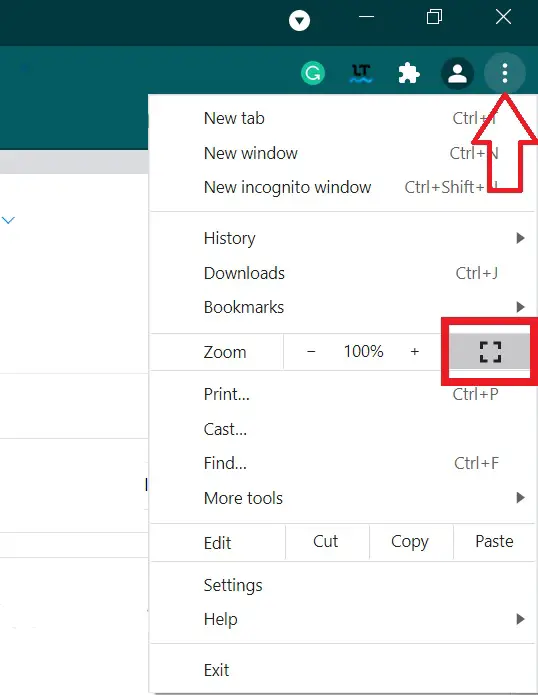
- Menu option: Click the three-dot menu (⋮) in the top-right corner, hover over Zoom, then click the full screen icon on the far right (⛶). This has the exact same effect as pressing F11, so it’s the go-to method for full screen without F11.
- Fn + F11: On many Windows 11 laptops with media-key keyboards, F11 is mapped to a brightness or media function by default — hold Fn + F11 instead.
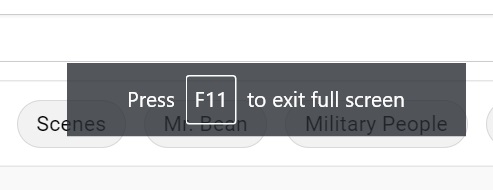
To exit, press F11 again.
How to Go Full Screen on Chrome on Mac
To make Chrome full screen on a Mac:
- Keyboard shortcut: Press Command (⌘) + Control + F.
- Green button: Click the green full screen button in the top-left corner of the Chrome window.
- Menu bar: Click View → Enter Full Screen.
To exit: press Command + Control + F again, or move your cursor to the very top of the screen and click the green button a second time.
Full Screen Shortcut for Microsoft Word, Excel & PowerPoint
- Word & Excel: Click the Ribbon Display Options button (top-right) and choose Auto-hide Ribbon — or use the keyboard path Alt, V, U.
- PowerPoint: Press F5 to start a presentation from the beginning, or Shift + F5 to start from the current slide. This is presentation full screen, not the same as a windowed full-screen toggle.
VLC Full Screen Shortcut
In VLC, press F during playback to toggle full screen — press it again, or hit Esc, to exit. Double-clicking the video window also works. If “F” ever conflicts with another program, reassign it under Tools → Preferences → Hotkeys.
How to Go Full Screen Without F11 (Keyboard, Menu, or Touchpad)
If your F11 key is disabled, remapped, or missing — common on compact and Chromebook-style keyboards — you have keyboard-free options:
- Chrome menu: Three-dot menu → Zoom → full screen icon. Identical result to pressing F11.
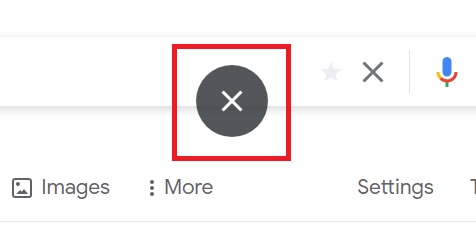
- Mouse only (to exit): Move your mouse to the very top of the screen. A bar drops down with an X button — click it to return to normal mode.
- Touchpad: Windows has no built-in touchpad gesture that triggers full screen — it’s not a standard Precision Touchpad action. If your laptop maker’s software supports custom gestures (check Settings → Bluetooth & devices → Touchpad, or the manufacturer’s trackpad utility), you can assign a shortcut like F11 to a gesture there, but there isn’t a default one to rely on.
Chrome Full Screen on Android, iPhone, and iPad
Mobile Chrome doesn’t have a manual, system-wide full screen toggle like desktop’s F11 — mobile OS navigation bars typically stay accessible — but you can still reclaim most of the screen:
- Scroll to auto-hide: On Android, iPhone, and iPad, scrolling down on any page tucks away the address bar and tab strip. Scroll up to bring them back.
- Videos: Tap the expand/full screen icon inside any video player (e.g., YouTube) to watch edge-to-edge.
- Landscape mode: Rotating to landscape maximizes usable space, especially for video.
- Desktop site (Android): Three-dot menu → Desktop site gives a layout closer to the full desktop experience, though it doesn’t remove Chrome’s own UI.
- Add to Home Screen (Android): Three-dot menu → Add to Home Screen creates a standalone shortcut that opens in a chrome-less, app-like view with no address bar or tabs — the closest thing Android has to true full screen browsing.
- Split View / Slide Over (iPad): If Chrome is running alongside another app, drag the divider or swipe the multitasking bar away to give Chrome the whole screen.
Apple’s iOS/iPadOS browser sandboxing means there’s currently no native “true” full screen toggle inside Chrome for iPhone or iPad — the steps above simply get you the most screen real estate available.
Taking a Screenshot While in Full Screen
Since the address bar and taskbar are already hidden, full screen mode is a quick way to grab a clean screenshot: use Windows + Shift + S (Windows) or Shift + Command + 4 (Mac), or your device’s standard screenshot shortcut on mobile.
Auto-Hide the Taskbar for a Permanent Full-Screen Feel
If you want every window to feel more immersive without pressing a shortcut each time:
- Right-click the Taskbar and select Taskbar settings.
- Open Taskbar behaviors.
- Enable Automatically hide the taskbar.
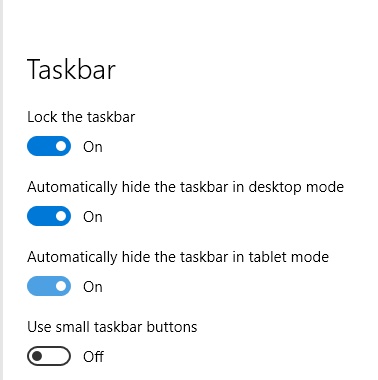
The taskbar tucks away whenever you’re not using it and reappears when you move your cursor to the bottom edge — useful alongside F11 for a genuinely clutter-free desktop.
Chrome Kiosk Mode (Always-On Full Screen)
If you need Chrome to open full screen and stay locked there — for a digital sign, POS terminal, or public kiosk — use kiosk mode:
- Right-click your Chrome shortcut and choose Properties.
- In the “Target” field, add
--kioskafter the file path (e.g.,chrome.exe --kiosk https://example.com). - Save and launch. Chrome opens directly into full screen with no toolbar, tabs, or easy way to navigate away.
To make Chrome open full screen every time without the kiosk restrictions, use --start-fullscreen instead of --kiosk in the shortcut’s target field. To exit kiosk mode, press Alt + F4 (Windows) or close Chrome via Task Manager.
Full Screen Shortcut Not Working? Try These Fixes
If your full screen shortcut suddenly stops responding — or Chrome gets stuck in full screen and won’t exit — work through these in order:
- Press F11 again (Windows) or Cmd + Ctrl + F again (Mac) — the most common fix.
- Press Esc. Some web apps and video players trap their own full screen state separately from the browser’s.
- Try Fn + F11 and check Fn Lock (Fn + Esc) — many laptops default the F-row to brightness or media keys.
- Restart the app. Close every Chrome window and reopen the browser.
- Disable extensions. Visit
chrome://extensionsand temporarily turn off recently installed extensions, then test again. - Update Chrome. Go to
chrome://settings/helpto install the latest version. - Confirm the app supports true full screen. Some apps only maximize the window rather than offering a real distraction-free mode — that’s an app limitation, not a broken shortcut.
- Use Alt + Tab to regain control if a full-screen game or app appears frozen; if that fails, Ctrl + Shift + Esc opens Task Manager so you can end the task.
- Reset Chrome settings as a last resort at
chrome://settings/reset.
Frequently Asked Questions
What is the full screen shortcut key?
F11, on both Windows 10 and Windows 11. It works in File Explorer and most web browsers, including Chrome. On Mac, the equivalent is Command + Control + F.
Which F key is full screen?
F11 is the standard full screen key on Windows. If pressing it does nothing, your laptop’s F-row is likely set to brightness, volume, or another hardware function by default — hold Fn + F11 instead, or toggle Fn Lock with Fn + Esc.
How do I make Chrome full screen?
Press F11 on Windows/Linux or Command + Control + F on Mac. You can also use the three-dot menu → Zoom → full screen icon, which has the identical effect.
How do I exit full screen?
Press F11 again (Windows) or Command + Control + F again (Mac). Esc also works on many pages, video players, and full-screen games.
Is the Windows 11 full screen shortcut different from Windows 10?
No. F11 works identically on both versions for browsers and File Explorer. The Windows + Shift + Enter shortcut for Microsoft Store apps applies to both as well.
Is there a touchpad gesture for full screen?
Not by default — Windows doesn’t ship a built-in Precision Touchpad gesture for full screen. Some laptop makers let you assign a custom gesture to a shortcut like F11 through their trackpad software, but you’d need to set that up yourself.
Why is my Chrome or Windows shortcut stuck in full screen?
This is usually caused by a frozen tab, a browser extension overriding the shortcut, or a webpage script controlling the window. Restarting the app or pressing the full screen shortcut again typically resolves it.
Does Chrome have full screen on Android and iPhone?
Not as a manual toggle for general browsing. Chrome mobile auto-hides the address bar when you scroll, and individual videos have their own full screen buttons.
Can I make Chrome open in full screen automatically?
Yes. Add –start-fullscreen to the target field of your Chrome desktop shortcut so it launches directly into full screen every time.
Final Thoughts
Whether you’re on a Windows desktop, a laptop with a remapped F-row, or Chrome on Mac, Android, or iOS, the pattern is the same: F11 (or Cmd + Ctrl + F on Mac) is the shortcut worth remembering first, the three-dot Zoom menu is your fallback when a physical key won’t cooperate, and Esc gets you out of almost anything in a pinch. Bookmark this guide so the right shortcut for your device is always one click away.
Also read: How To Switch Tabs In Chrome In Full Screen Mode
Taskbar in Windows 10
How to Switch Between Desktops on Windows 10
Degree Symbol on Mac