How to Transcribe Audio to Text in Google Docs (Easy Guide)
Have you ever wished you could turn your spoken words or recorded audio into written text without typing everything out? Google Docs can help with that! Using its speech-to-text feature, you can transcribe audio to text in Google Docs for free.
This is really useful for students, teachers, journalists, podcasters, or anyone who wants to save time. In this guide, we’ll explain—step by step—how to transcribe audio to text in Google Docs, what works well, what doesn’t, and some tips to get the best results.
Can Google Docs Transcribe Audio?
Yes — Google Docs can transcribe audio to text through the built-in Voice Typing tool. This feature lets you speak directly into a microphone while Google Docs converts your words into text in real time.
While it’s not as advanced as professional transcription software, it’s free, easy to use, and works well for many common scenarios. The one important thing to know upfront: Google Docs cannot directly upload and transcribe an audio file. It listens through your microphone only — but there are workarounds for recorded audio (covered below).
How to Transcribe Audio to Text in Google Docs (Step-by-Step)
Here’s exactly how to use Google Docs audio to text using the Voice Typing feature:
What You Need Before You Start
- Google Chrome browser — Voice Typing only works in Chrome
- A Google account
- A working microphone (built-in or external)
- A stable internet connection
Step-by-Step Guide
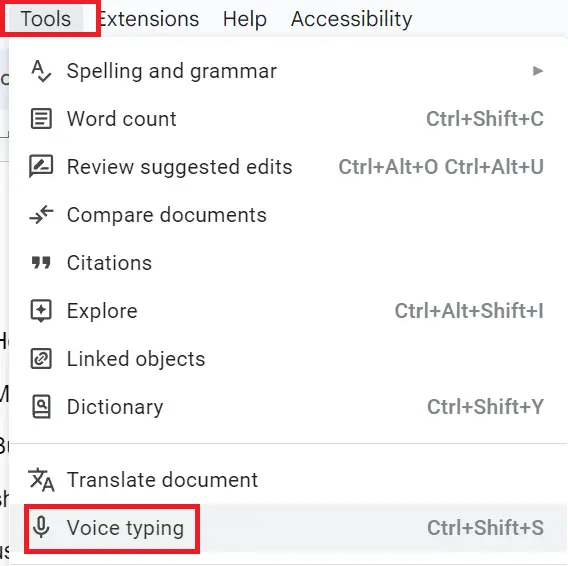
- Open a new or existing Google Doc in the Chrome browser.
- Go to the top menu and click Tools > Voice Typing.
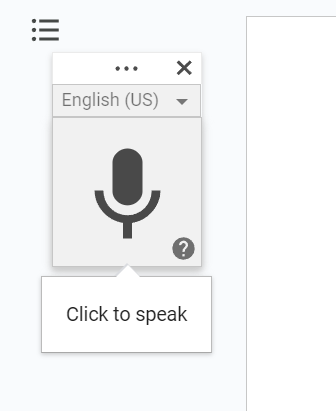
- A small microphone icon will appear on the left side of your document.
- If prompted, click Allow to give Chrome access to your microphone.
- Click the mic button — it turns red when active.
- Start speaking clearly into your microphone. Your words will appear on the page as you talk.
- Click the mic button again to stop recording.
Useful Voice Commands for Google Docs Transcription
You can control formatting entirely by voice — no keyboard needed. Say these commands out loud while Voice Typing is active:
| Voice Command | What It Does |
|---|---|
| “New line” | Moves to the next line |
| “New paragraph” | Inserts a paragraph break |
| “Period” / “Comma” / “Question mark” | Inserts punctuation |
| “Bold” / “Italics” / “Underline” | Applies text formatting |
| “Select all” | Selects all text |
| “Undo” | Undoes the last action |
| “Stop listening” | Pauses Voice Typing |
Note: Voice commands work best when your language is set to English. You can find the full list under Tools > Voice Typing > How to use voice typing.
How to Transcribe an Audio File to Text in Google Docs
One of the most common questions is: can Google Docs transcribe an audio file? The short answer is — not directly. Google Docs Voice Typing only listens through your microphone. It cannot import an MP3, WAV, or video file and automatically produce a transcript.
But here are two workarounds to transcribe audio files to text in Google Docs:
1: Play Audio Through Your Speakers
- Open your audio or video file in any media player (VLC, QuickTime, etc.)
- Open Google Docs and activate Voice Typing (Tools > Voice Typing)
- Press play on your audio file and let the microphone pick it up
- Google Docs will type out what it hears in real time
Best for: Quick, simple transcription when accuracy doesn’t need to be perfect.
2: Use a Virtual Audio Cable (Better Accuracy)
A virtual audio cable is a free software tool that routes your computer’s audio output directly into the microphone input — feeding the sound straight into Google Docs without room noise. This gives noticeably cleaner results.
- Download and install a virtual audio cable tool (e.g., VB-Audio Virtual Cable for Windows)
- Set your computer’s playback device to the virtual cable output
- Set Chrome’s microphone input to the virtual cable
- Activate Voice Typing in Google Docs and play your audio file
Best for: Longer recordings, interviews, or podcasts where you need better accuracy.
So yes, you can transcribe MP3 to Google Docs or transcribe WAV to Google Docs — you just need to play the audio and let Voice Typing capture it.
How to Select a Language for Google Docs Transcription
Google Docs audio transcription supports over 100 languages. To change your language:
- Open Voice Typing (Tools > Voice Typing)
- Click the language dropdown above the microphone icon
- Select your language or dialect
- Start speaking — Google Docs will transcribe in that language
This is especially useful for non-English speakers. For example, French users can select “Français” to get transcription audio en texte Google Docs in their language.
Google Docs Transcription Accuracy: What to Expect
You may wonder: how accurate is Google Docs transcription?
The honest answer is it depends. For clear speech in a quiet environment, accuracy is typically 90–95%. But it drops with:
- Heavy accents or fast speech
- Background noise or echo
- Low-quality microphones
- Technical jargon or uncommon words
- Multiple speakers talking at once
Tips for the best Google Docs audio to text accuracy:
- Use a quiet room with minimal echo
- Speak slowly and clearly
- Use a quality external microphone if possible
- For recorded audio, use a virtual audio cable instead of speakers
- Proofread and edit immediately after transcribing
It’s not as accurate as paid tools, but as a free audio to text Google Docs solution, it’s excellent for everyday use.
How to Format a Transcript in Google Docs
Once transcription is done, formatting makes your document easier to read and share. Here are the best practices:
- Use Speaker Labels: Bold or italicize speaker names (e.g., John:) to clearly identify who said what.
- Use Headings: Use H2 for main sections (topics or speakers) and H3 for subsections to organize the transcript.
- Add Punctuation: Voice Typing often skips punctuation — go back and add periods, commas, and paragraph breaks.
- Use Bullet Points: Great for listing key takeaways or action items from the transcript.
- Proofread: Use a tool like Grammarly to catch remaining errors.
Troubleshoot Google Docs Audio Transcription Issues
If Google Docs transcription isn’t working, here’s how to fix the most common problems:
| Problem | Fix |
|---|---|
| Microphone icon is grayed out | Switch to Google Chrome — Voice Typing doesn’t work in other browsers |
| Google Docs can’t hear the microphone | Go to Chrome Settings > Privacy > Site Settings > Microphone and allow docs.google.com |
| Transcription stops after a few seconds | Speak continuously or check your internet connection |
| Words are misheard or misspelled | Speak slower, reduce background noise, move closer to the mic |
| Voice commands not working | Make sure your language is set to English |
| Voice Typing menu missing | Update Chrome to the latest version |
Limitations of Google Docs Audio Transcription
Before you rely on Google Docs to transcribe audio, it helps to know what it can’t do:
- Chrome-only — doesn’t work in Firefox, Safari, or Edge
- No audio file upload — can only listen via microphone in real time
- No speaker identification — can’t label who said what automatically
- No timestamps — transcripts don’t include time markers
- No automatic punctuation — you must dictate punctuation manually
- Requires internet — offline transcription is not supported
- Less accurate with accents — non-native speakers may see more errors
For basic dictation and everyday notes, these limitations are manageable. For professional work — interviews, podcasts, legal recordings — a dedicated tool may serve you better.
Best Alternatives If Google Docs Transcription Isn’t Enough
If you need more than what Google Docs audio to text offers, these tools are worth considering:
- Otter.ai — Transcribes audio files, identifies multiple speakers, generates summaries. Free plan available.
- Descript — Edit audio/video by editing the transcript text. Great for podcasters and video creators.
- Rev.com — AI and human transcription options. Best for legal, medical, or broadcast-quality needs.
- Whisper by OpenAI — Free, open-source, highly accurate, works offline. Requires some technical setup.
For most people, though, Google Docs speech to text is a perfectly capable free starting point.
Can Google Docs transcribe audio files?
Not directly. Google Docs Voice Typing only listens through your microphone — it cannot import an MP3 or WAV file. However, you can play the audio file through your speakers (or a virtual audio cable) while Voice Typing is active, and it will transcribe what it hears in real time.
Does Google Docs support video transcription?
Yes, but indirectly. You must play the video out loud (or route audio through a virtual cable) while Voice Typing is active. Google Docs will then transcribe the audio from the video in real time.
How long can an audio clip be for Google Docs transcription?
There is no strict time limit, but very long recordings may require breaks as Voice Typing can occasionally pause or stop. For recordings over 30 minutes, consider splitting the audio into shorter segments for best results.
Is Google Docs good for audio to text?
Yes, for basic needs. Google Docs audio transcription is free, easy to use, and reasonably accurate for clear speech in quiet environments. For professional work requiring speaker labels, timestamps, or audio file uploads, a dedicated tool like Otter.ai or Rev.com will serve you better.
How to convert speech to text in Google Docs?
Open a Google Doc in Chrome, click Tools > Voice Typing, then click the microphone icon and start speaking. Google Docs will convert your speech to text in real time. You can also say voice commands like ‘new paragraph’ or ‘period’ to control formatting hands-free.
Does Google Docs Voice Typing work on mobile?
The Voice Typing feature in Google Docs is designed for desktop Chrome. On mobile, you can use your phone’s built-in keyboard dictation instead — tap the microphone icon on your keyboard while using the Google Docs app to achieve a similar result.