How to Reset Chrome: Default Settings for Windows, Mac, Android
Google Chrome is a widely used browser known for its speed, reliability, and features. However, over time, it can become slow, crash frequently, or show unwanted pop-ups. In such cases, the best solution is to reset Chrome to default settings.
A Chrome reset restores your browser to its original state without requiring you to uninstall and reinstall it. This guide will explain:
- What happens when you reset Google Chrome
- Step-by-step instructions for Windows, Mac, Android, and iPhone
- Advanced options like Chrome factory reset, reset Chrome cache, extensions, and flags
- Fixes for issues like Chrome keeps crashing or Chrome malware reset
What Happens When You Reset Chrome?
When you perform a Chrome reset settings action, these changes occur:
- Default search engine is reset
- Homepage and startup pages are restored to original defaults
- Pinned tabs are removed
- Extensions and themes are disabled (but not permanently deleted)
- Cookies and site settings are cleared
How to Reset Chrome on Windows & Mac
Follow these steps to reset Chrome browser on your computer:
- Open Google Chrome.
- Click the three-dot menu (⋮) in the top-right corner.
- Select Settings.
- In the left panel, click Reset settings.
- Choose Restore settings to their original defaults.
- Confirm by clicking Reset settings.
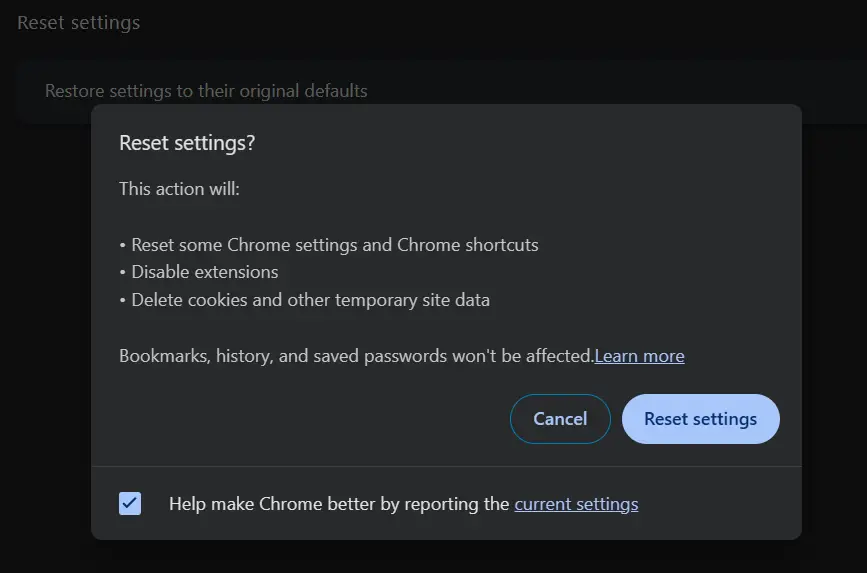
Alternatively, type this into the address bar for a direct shortcut:
chrome://settings/resetProfileSettings
How to Reset Chrome on Mobile Devices
Reset Chrome on Android
To reset Google Chrome on Android there are two main ways:
Method 1: Reset Chrome via Android Settings (Full Reset / Chrome Factory Reset)
This option works like a Chrome factory reset and completely clears the app’s data:
- Open your phone’s Settings.
- Tap Apps or Apps & notifications (varies by device).
- Scroll down and select Chrome.
- Tap Storage & cache.
- Choose Clear Storage (or Clear Data on some devices).
- Confirm when prompted.
Method 2: Reset Chrome from Within the App (Clear Browsing Data)
If you just want to clear temporary files or resolve Chrome slow reset issues without wiping all data:
- Open the Chrome app.
- Tap the three-dot menu (⋮) in the top-right corner.
- Select Settings.
- Scroll down and tap Privacy and security.
- Choose Clear browsing data.
- Select the types of data to clear (e.g., cached images, cookies, site data).
- Tap Clear data to finish.
Reset Chrome on iPhone / iPad
To reset Chrome on iPhone:
- Open Chrome.
- Tap the three-dot menu → Settings.
- Go to Privacy → Clear Browsing Data.
- Select data types (cookies, cache, site data) → Tap Clear Browsing Data.
Advanced Reset Options in Chrome
Reset Google Chrome Flags
If experimental features are causing issues:
- Go to
chrome://flags/ - Click Reset all to default
Reset Chrome Cache
Clearing cache can improve performance without a full reset:
- Open Chrome → Menu → Settings → Privacy and security → Clear browsing data
- Select Cached images and files
Reset Chrome Extensions
Extensions often cause crashes or slowdowns:
- Go to
chrome://extensions/ - Disable or remove unnecessary add-ons
- After reset, re-enable only trusted ones
Chrome Factory Reset for Malware or Errors
If Chrome is hijacked by malware or pop-ups:
- Go to Settings → Reset and clean up.
- Select Clean up computer (Windows only).
- Let Chrome scan for harmful software.
- Perform a full Chrome factory reset if problems persist.
Final Thoughts
Whether your browser is crashing, slowing down, or filled with pop-ups, the fastest way to fix it is to reset Google Chrome. You can perform a Chrome reset settings on Windows, Mac, Android, or iPhone in just a few clicks.
For deeper issues like malware or sync errors, try a Chrome factory reset, clear extensions, or reset Chrome sync. After resetting, re-enable only trusted extensions and keep Chrome updated for the best performance.