Gmail Autocomplete: How to Use, Turn On/Off & Fix Predictive Text
If you’ve ever started typing an email in Gmail and noticed gray, ghost-like text appearing ahead of your cursor — finishing your sentence before you do — that’s not autocorrect. It’s Gmail Autocomplete, officially called Smart Compose, Gmail’s built-in predictive text feature. This guide covers how Gmail Autocomplete works, how to accept or use the suggestions, how to turn it on or off, and how to fix it when it’s not working as expected.
What Is Gmail Autocomplete (Smart Compose)?
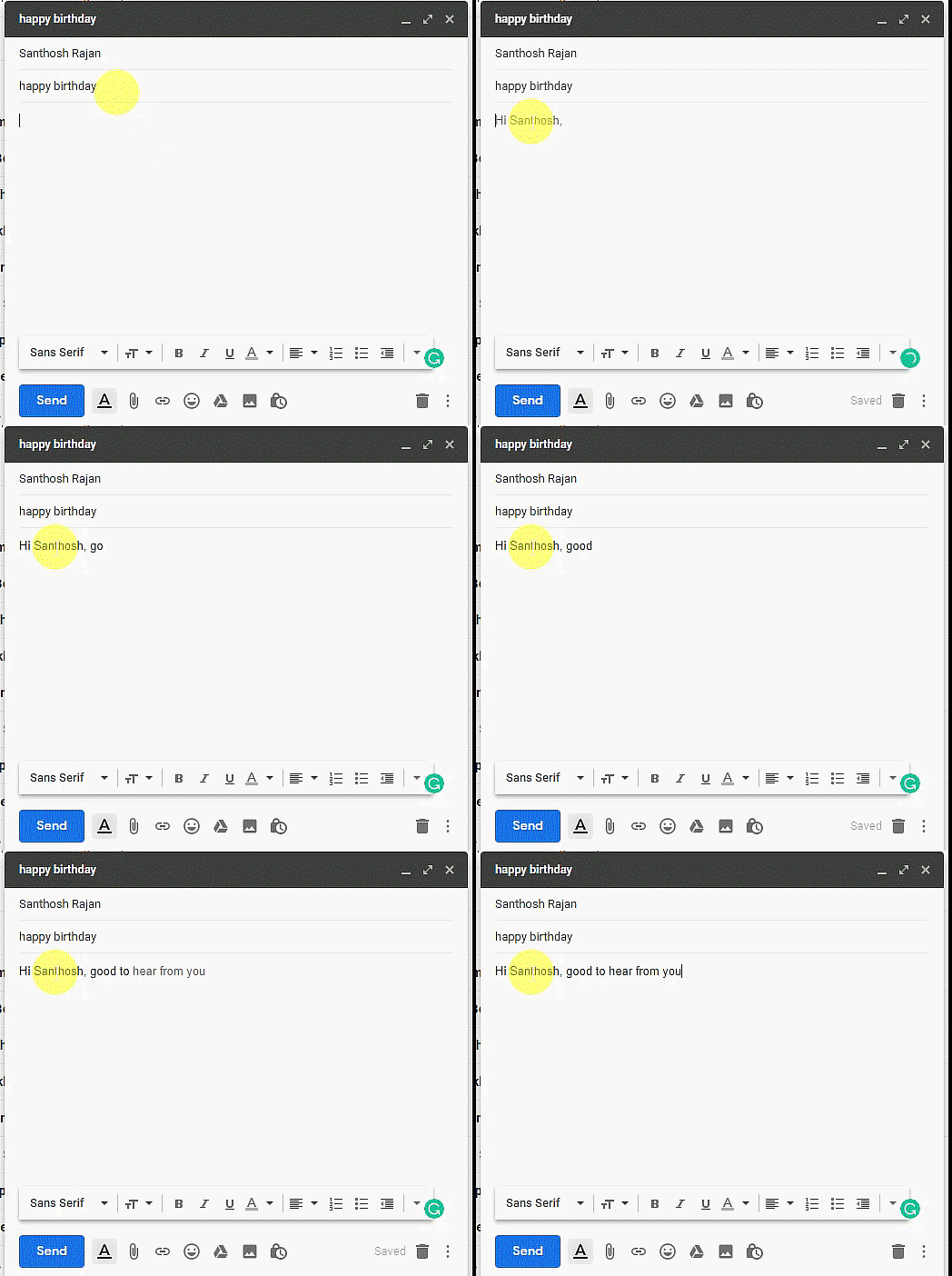
Gmail Autocomplete is Gmail’s AI-powered writing assistant. As you type the body of an email, it analyzes your sentence and suggests words, phrases, or entire sentence endings in light gray text, right where you’re typing. It’s different from spell-check or grammar suggestions — it’s actively trying to predict and write the rest of your sentence for you.
It’s also worth knowing this is a separate feature from the email address suggestions that appear in the “To” field when you’re adding a recipient — that’s a different autocomplete system built around your contacts, not your writing.
How to Accept a Gmail Autocomplete Suggestion (Desktop and Mobile)
This trips up a lot of people the first time, because the suggestion looks like it’s already part of your email, but it isn’t typed yet.
On desktop:
- When you see the gray suggested text, press the Tab key to accept it.
- You can also press the Right Arrow key on some versions to accept the suggestion.
- If you don’t want the suggestion, just keep typing normally — it disappears and updates based on your new input.
On mobile (Android/iOS):
- Suggested words appear as a tappable bar just above the keyboard.
- Tap the suggested word or phrase to insert it into your email.
- If you don’t want it, simply keep typing and it updates automatically.
There’s no “Enter” or “Space” shortcut for accepting suggestions — using those will just create a line break or empty space instead, which is the most common reason people feel like the suggestion “isn’t accepting.”
How to Turn On or Off Gmail Autocomplete
Gmail Autocomplete is turned on by default for most accounts, but here’s how to control it:
On Desktop
- Open Gmail in your browser.
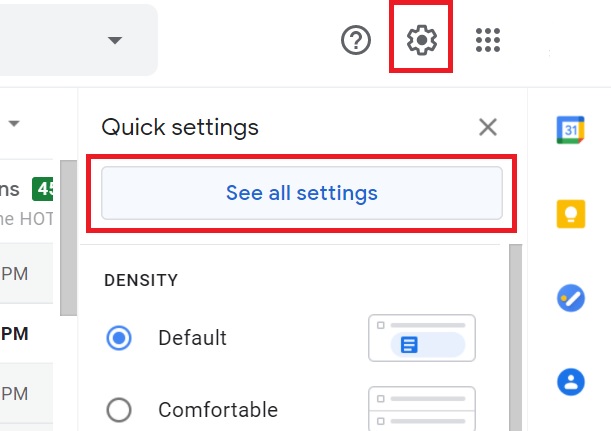
- Click the gear icon (Settings) in the top-right corner.
- Click See all settings.
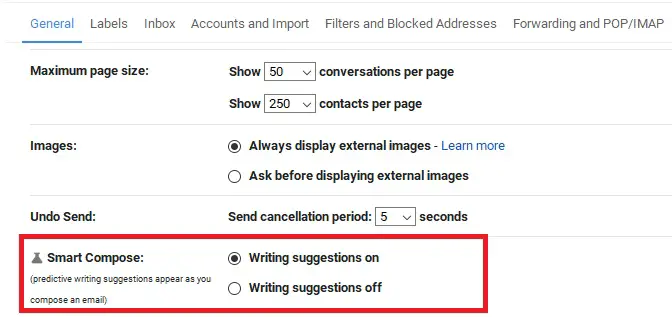
- Stay on the General tab and scroll down to Smart Compose.
- Select Writing suggestions on to enable Gmail Autocomplete, or Writing suggestions off to disable it.
- Scroll to the bottom and click Save Changes.
Smart Compose Personalization
Gmail also has a related setting that lets Gmail Autocomplete learn your personal writing style over time:
- In the same General settings tab, scroll to Smart Compose personalization.
- Choose Personalization on to let Gmail tailor suggestions to how you normally write, or Personalization off to keep suggestions generic.
- Click Save Changes.
Personalized suggestions are private to your account — Google notes that no one else, including admins on a work or school account, can see them.
On the Gmail Mobile App
- Open the Gmail app and tap the menu icon (three lines) in the top-left.
- Scroll down and tap Settings.
- Select your account.
- Look for Smart Compose and toggle Gmail Autocomplete on or off.
(Availability of this toggle can vary slightly depending on your app version and account type.)
How Gmail Autocomplete Actually Works
Gmail Autocomplete uses machine learning trained on common phrases, writing patterns, and context — similar in spirit to how Google predicts what you’re typing in a search bar. As you write, it looks at:
- The words you’ve already typed in that sentence
- The general context of the email (e.g., greetings, sign-offs, common phrases like “let me know if you have any questions”)
- Your own past writing patterns, if personalization is turned on
It then predicts a likely ending and displays it in gray, ahead of your cursor, for you to accept or ignore. The more you use Gmail, the more Gmail Autocomplete adapts to your specific tone and common phrases — though it’s general suggestions (like greetings and sign-offs) more often than fully custom ones.
How to Fix Gmail Autocomplete Not Working
If suggestions aren’t showing up at all, work through these steps:
- Check the Smart Compose setting. Go to Settings > General > Smart Compose and confirm it’s set to “Writing suggestions on.”
- Make sure you’re using the new Gmail interface. Gmail Autocomplete doesn’t work in older/basic HTML Gmail views.
- Check your language settings. Gmail Autocomplete only works in supported languages, and mismatched language settings can silently disable it.
- Clear your browser cache, or try a different browser, in case a corrupted cache is blocking the feature from loading.
- Update the Gmail app if you’re on mobile — outdated app versions sometimes drop support for newer features temporarily.
- Give it time to “learn.” If suggestions feel sparse or generic, this is often by design — Gmail Autocomplete intentionally avoids over-suggesting until it has more writing patterns to work from.
Quick Recap
| What you want to do | How |
|---|---|
| Accept a suggestion (desktop) | Press Tab |
| Accept a suggestion (mobile) | Tap the suggested word above the keyboard |
| Turn Gmail Autocomplete on/off | Settings > General > Smart Compose |
| Personalize suggestions | Settings > General > Smart Compose personalization |
| Fix suggestions not appearing | Check settings, language, cache, and app version |
Gmail Autocomplete is meant to be a quiet time-saver — once you know that Tab is the accept key and where the on/off toggle lives, it’s a one-time, thirty-second setup.
The instruction to turn OFF writing suggestions does not turn it off. There is NO WAY to turn it off and I Hate the feature!
If it doesn’t work for you, then you can try to turn OFF Personalization-
Go to Settings > General and scroll down to “Smart Compose personalization.” Select Personalization off.